
Is your industrial electromechanical equipment suffering the potential safety hazard? Do you experience not just voltage fluctuations, but also inconsistent frequency and distorted power waveform? In many industrial and manufacturing environments, unstable power is the primary threats for:
- The unstable operation of the system may result in frequently restarts, automatic shutdowns, and abnormal operation
- Long term voltage fluctuations can accelerate the aging of key components in equipment and shorten its service life
- Equipment damage caused by over voltage or under voltage; Severe over voltage may break out insulation, causing leakage, short circuit, and even fire
- Decreased efficiency and increased energy consumption
While a standard voltage stabilizer is a common solution, a more advanced device—the voltage and frequency stabilizer—offers completely protection by also regulating frequency and purifying the incoming power waveform into a pure sine wave to equipment.
But what exactly is the difference? And which one does your application truly need? In this guide, we breaks down the core differences between these two power conditioning devices, topology principles, pros and cons, and ideal applications of each to help you make an informed decision of which device best fits your power protection needs.
What is a Standard Voltage Stabilizer?
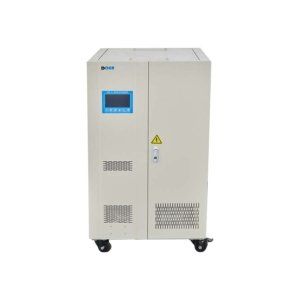
A standard voltage stabilizer, often a servo-controlled or SCRs / thyristor controlled stabilizer, is designed to solve one primary problem: unstable voltage. It takes an fluctuating input voltage (voltage variation swing ±15%-±30%, which can be too high or too low) and delivers a consistent, rated output voltage (e.g., 380V or 220V).
Primary Function:
Corrects voltage variations (under-voltage and over-voltage), grid noise, sags and electrical surges etc.
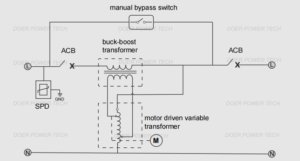
Topology design – working principle
Design Topology / Working Principle (e.g., Servo Type): It uses a servo motor to drive a carbon brush over an auto-transformer’s winding. This changes the winding ration of the transformer, effectively “bucking” or “boosting” the voltage to maintain a steady output. It’s a robust, electromechanical solution.
What is a Voltage & Frequency Stabilizer?
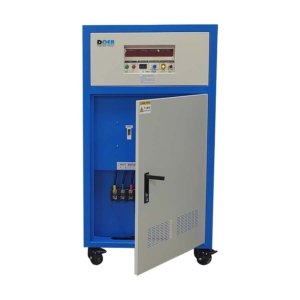
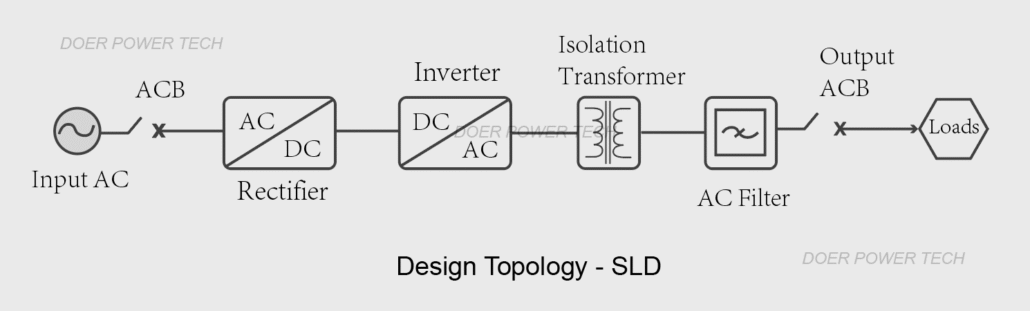
This is a more advanced or sophisticated power conditioning device, often referred to as a static frequency converter or a IGBT double-conversion stabilizer. It goes beyond simple voltage regulation to provide a perfect, isolated power output. It regulates or stabilizes both voltage and frequency, and it cleans the waveform. Its design topology is far more complex than a standard voltage stabilizer, typically involving a double-conversion process: AC-DC-AC Conversion, this process makes it possible to build up a cleaner more stable waveform than the direct AC input.
Primary Functions:
- Regulates voltage
- Regulates frequency
- Provides complete electrical isolation
- Cleans the output waveform (eliminating harmonics, spikes, and noise)
Topology Design -Working Principle (AC-DC-AC Conversion):
- Rectify (AC-DC): The incoming, unstable AC power (with fluctuations in voltage and frequency) is first converted into DC power.The step effectively isolates the input power from the output, eliminating frequency variations and waveform distortion
- Filtering: This DC power is then filtered to smooth out any remaining ripples or noise.
- Inversion(DC-AC): Finally, a high-precision inverter converts the clean DC power back into a perfect, stable AC power supply with a precisely regulated voltage and frequency in excellent pure sine wave (e.g., 50Hz or 60Hz, accurate to ±0.1%).
Key Differences:
here is a direct comparison sheet of their core characteristics:
| Feature | Standard Voltage Stabilizer | Voltage & Frequency Stabilizer |
|---|---|---|
| Core Function | Voltage regulation only | Voltage regulation, frequency stabilization, and waveform purification |
| Working Principle | Tap-changing (servo controlled) | Double-conversion (AC-DC-AC) |
| Output Waveform | Same as input (would be distorted) | Pure, clean, and regenerated sine wave |
| Frequency Control | No (output frequency follows input) | Yes (output frequency is regulated and stable) |
| Response Time | Moderate (10ms - 50ms) | Ultra-fast (< 10ms) |
| Isolation | No (input and output are electrically connected) | Yes (complete galvanic isolation) |
| Complexity | Relatively simple | High (uses power electronics like IGBTs) |
Pros and Cons: Which One Suits Your Needs?
Standard Voltage Stabilizer
Advantages
- Cost-Effective: Significantly lower investment, single-purpose solution for basic voltage protection. Lower maintenance costs, compared to voltage & frequency stabilizers, making it accessible for small businesses and residential use.
- Robust & Reliable: Simple, time-tested technology, ideal for rugged industrial environments.
- Simple in design: easier for troubleshooting and maintenance—no specialized technical expertise required.
- Higher energy efficiency: Minimal power loss on running (typically 3%-5%)
- Fast Voltage Correction: Servo and static models offer fast response times to voltage fluctuations, protecting equipment from surges and sags.
- Handles High Surge Currents: Excellent for starting heavy motors and inductive loads.
Limitations
- No Frequency Correction: Cannot satisfy the sensitiveequipment for a accurate frequency need (e.g., incoming frequency supply in fluctuation from generators ).
- Mechanical Wear:Servo model has moving parts that experience wear over time, Servo motors and carbon brushes require periodic maintenance.
- Input & Output No Isolation: Does not isolate the load from the grid, so electrical noise, harmonics and grid interference can impact theconnected equipment.
Voltage & Frequency Stabilizer
Advantages
- Complete Power Protection: Provides the highest level of power quality, eliminating all types of disturbances.
- Pure Sine Wave Output:Delivers a clean and pure sine wave, critical for sensitive loads: Ideal for electronics, IT, medical, and high-precision equipment.
- Generator Compatibility: Can stabilize the “dirty” and frequency-unstable power from generators, making it act like utility power.
- Frequency Conversion: Can easily convert 50Hz to 60Hz or vice versa, crucial for equipment designed for a different power standardin different regions.
- Complete Isolation: Provides safety against shock, and filters high-frequency noise from the input supply. acts as a barrier to electromagnetic interference, preventing grid fluctuations from disrupting sensitive devices.
Limitations
- Higher Cost: Advanced components and complextopology design result in a significantly higher purchase price than standard voltage stabilizer.
- Lower Efficiency: The double-conversionAC-DC-AC causes higher power loss (5–15%) during operation, leading to higher energy costs.(though standard voltage stabilizers are 95-98% efficient).
- Complexity: regular maintenance is more involved- requires a more skilled technician for maintenance and troubleshooting. Annual calibration is needed if necessary.
Ideal Application Scenarios
Understanding where each device excels is key to making the informed choice.
Application scenarios of voltage stabilizer / regulators
Choose a Standard Voltage Stabilizer for applications where only voltage fluctuations are a concern, and the connected equipment does not require frequency regulation or pure sine wave power. It is widely used in residential, commercial and industrial scenarios:
- Industrial Plants with Motors: Factories running large pumps, compressors, fans, and basic manufacturing equipment that only require stable voltage to operate.that are tolerant of minor frequency variations.
- Whole-Facility Regulation: For an entire workshop or building with mixed loads, a standard stabilizer is a cost-effective solution for voltage correction.
- HVAC Systems: Large air conditioning and refrigeration units benefit from the robust voltage protection.With the need of voltage stability and surge-handling capacity.
- Residential Use: Protecting home appliances like AC, fridges, washing machines from grid voltage fluctuations in areas with unstable power supply.
- Remote or isolated area: Remote areas with poor grid quality where voltage sags/surges are common, but frequency remains relatively stable.
In these scenarios, a voltage stabilizer provides cost-effective, reliable protection against voltage fluctuation, sags and surges—there is no need to invest heavily in the advanced features of a voltage & frequency stabilizer.
Application scenarios of voltage & frequency stabilizers / converters
Voltage & frequency stabilizers are essential for applications where power quality is non-negotiable, and the connected equipment is sensitive to voltage fluctuations, frequency drifts. They are the preferred solution for critical, sensitive applications:
- Data Centers &IT infrastructure: Servers and networking equipment are extremely sensitive to both voltage and frequency quality. A clean pure sine wave power and frequency control is non-negotiable.
- Healthcare Facilities: Hospitals and medical centers rely on life-support systems, CT scanners, lab analyzers and patient monitoring devices that demand ultra-quality Frequency drifts or waveform distortion can compromise diagnostic accuracy or even endanger patient lives.
- High-Precision Manufacturing: Semiconductor production, CNC machining, Robotic arms and microelectronics manufacturing rely on stable power to ensure product quality and process accuracy that only a double-conversionvoltage frequency stabilizer can provide.
- Aerospace & Defense: Radar systems, navigation equipment and military hardware require precise frequency control and pure power—oftencome with customized frequency 400Hz, 660Hz and 800Hz etc.
- Applications with Generator Power: Any critical process that relies on a backup generator will benefit greatly, as generators often produce unstable frequency.
- Export Equipment Testing:Facilities using imported machinery (e.g., 60Hz equipment in a 50Hz grid) benefit from the frequency conversion capability of the frequency converter stabilizer. If you’re manufacturing equipment for 60Hz countries but are in a 50Hz region, a frequency converter stabilizer is essential for testing.
- Marine & Offshore Systems: Shipboard power systems and offshore oil/gas rigs face frequent frequency fluctuations—the voltage and frequency converterstabilizers maintain consistent power for norm operational.
How to Make Your Decision
Both voltage stabilizers and voltage & frequency stabilizers play critical roles in power protection, but they serve entirely different purposes. Here’s a simple framework to guide your decision:
Choose a Voltage Stabilizer in case: You only need to correct voltage fluctuations, your equipment is not sensitive to frequency or waveform quality, and budget is a primary concern.
Choose a Voltage & Frequency Stabilizer in case: You face voltage fluctuations and frequency drifts, your equipment requires pure sine wave power, or you operate mission-critical or high-precision systems where power quality is non-negotiable.
For most small businesses and residential users, a voltage stabilizer is the practical and cost-effective choice. For sensitive equipment like data centers, hospitals and aerospace applications, a voltage & frequency stabilizer is not just an investment—it’s a necessity to ensure reliable, uninterrupted operation.
In a word, Ask yourself these questions before a decision is made:
- What is my load? Is frequency stability a concern? Does my equipment powered by a generator- Voltage & Frequency Stabilizer?
- What is my budget for protection? Standard stabilizers are the economical choice; Voltage and Frequencystabilizers are an investment in the highest level of power quality.
- Do I need to convert frequency? If you’re operating 60Hz equipment on a 50Hz grid, a Voltage and Frequencyconverter/stabilizer is your only solution.
Conclusion
Both standard voltage stabilizers and voltage & frequency stabilizers play vital roles in protecting electrical equipment. The choice ultimately depends on the sensitivity of your load and the nature of your power problems.
Voltage stabilizers offer simple, affordable voltage correction for basic needs, while voltage & frequency stabilizers deliver comprehensive power conditioning for the most demanding, high-precision applications. By understanding the key differences in their working principles, pros and cons, and ideal use application, you can make an informed decision that protects your equipment, minimizes downtime and maximizes return on investment. Whether you go for a basic voltage stabilizer or an advanced voltage & frequency stabilizer, investing in power protection is always a smart choice.
If you are unsure which technology is right for your specific application, our experts is here to help. Contact us now for a free consultation.

