
Is your sensitive electronic equipment frequently malfunctioning? You may suffering the constant threat from grid noise or electrical surges, and might be experiencing voltage fluctuations. In many parts of the world, an unstable power supply is a common issue that can significantly shorten the lifespan of your industrial appliances and lead to unplanned downtime, costly repairs or replacements , and significant financial losses. The solution? A automatic voltage stabilizer.
But with various types available, how do you choose the correct one? This guide will walk you through everything you need to know, from basic working principles to the key factors for making the right purchase for your industrial needs. In this article, a step-by-step selection to help you make a cost-effective, long-run voltage stabilizer, and long-term investment. This guide breaks down the most common types of voltage stabilizers on the market, their core functionality and why you need a voltage stabilizer is non-negotiable.
What Is a Voltage Stabilizer, and Why do you need one?
A voltage stabilizer is an electrical device installed between your incoming power and critical equipment that automatically regulate or correct the voltage from an unstable power source to a safe, constant level to a load at its output terminals regardless of changes in the input voltage or load conditions. Its core mission is to monitor the grid voltage—protecting your electrical equipment from damaging in a long time run under poor incoming power supply, You can imagine, equipment like fridges, air conditioners, medical equipment, and industrial machinery can suffer from burning out circuits with no voltage stabilizers when they exposed to the risks of over-voltage, can cause motors to overheat and fail under-voltage with no voltage stabilizer, and can cause random spikes when exposed to the risks of electrical transients. A well-selected stabilizer not only preserves your equipment but also safeguards worker safety, maintains production quality, and avoids the unexpected downtime.
Common Types of Voltage Stabilizers: Design, Function & Use Cases
While all voltage stabilizers share the same core goal—maintaining a constant output voltage—their topology design, precision, durability, and suitability for different circumstances vary completely. We break down the three primary industrial-grade stabilizer types available on the market as below, to help you make the right decision to your needs.
Servo Voltage Stabilizer
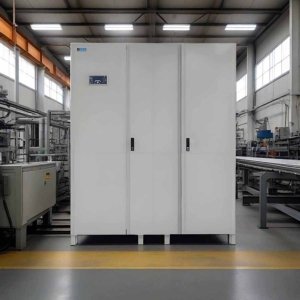
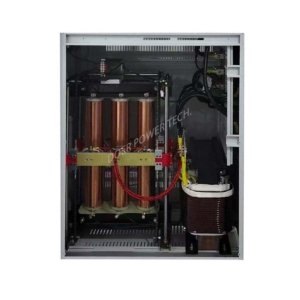
The servo voltage stabilizer is the most widely used and versatile option for most industrial applications, benefited for its unbeatable balance of precision, affordability, and reliability. The design principle of it comprises transformers and compensation coils and a servo motor. When supply voltage fluctuations occur, the system automatically drives the servo motor to change the position of the carbon brush to adapt the input voltage to output voltage mechanically, and to change the voltage to the desired level, which is ensuring a continuous, smooth and very stable output voltage. and a servo motor to make real-time voltage adjustments, It leverages a micro-controller module with servo motor making it ideal for facilities with variable grid power.
How is works?
The stabilizer’s control circuit continuously samples the output voltage. If the output deviates from the predetermined voltage, the micro-controller sends a signal to the servo motor, which rotates a carbon brush connected to buck-boost transformer. Repositioning the carbon brush alters the winding ratio of the transformer, adjusting the output voltage back to the predetermined volts.
Key Benefits
- Capable of handling larger load ratings, suitable for the load with high-inrush current start-up, especially for applicable to inductive load applications.
- Independent phase control: maintains each phase voltage stable irrespective of load unbalance.
- Cost-effective and easy to source, with a lifespan of 20+ years when properly maintained.
- Simple design allows for straight forward repairs and part replacements.
Ideal Applications
- All kinds industrial electrical appliances, manufacturing, commercial buildings, and any setup requiring consistent power for mixed electrical loads.
- Power supply substation
- Medical devices and labs for scientific research facility
- Electric machinery,motor and pump etc.
Induction Voltage Stabilizer
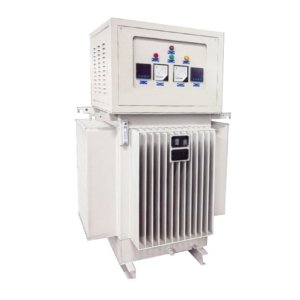
For harsh, remote, or low-maintenance industrial environments, the Oil-immersed Induction voltage stabilizer is the optimal option. It shares the servo stabilizer’s voltage regulation goal but uses a more robust mechanical design with no wearable parts, making it nearly maintenance-free. Oil-Immersed Electronic Induction Voltage Regulator / Stabilizer has durable mechanism and is friendly applicable to large power rating load. Conventional conductive mechanism improved energy conservation and heat dissipating efficiency.
How It Works
Oil-immersed induction voltage stabilizer (induction voltage regulator) operates based on the principle of electromagnetic induction, using oil as the main insulation and cooling medium. By utilizing magnetic field deflection angle to stabilize voltage, the voltage is linearly adjusted without any jump, tap surge, or waveform mutation. Instead of repositioning a carbon brush, the stabilizer rotates the secondary transformer winding to adjust its distance and orientation relative to the primary winding. This change modifies the magnetic field coupling between the winding, increasing or decreasing the output voltage to the correct level—no tap repositioning required.
Key Benefits
- Near-zero maintenance—its mechanical simplicity eliminates wearable parts like carbon brushes, shafts, or bearings.
- Exceptionally robust build, making it ideal for dusty, humid, outdoor, or remote facilities where regular maintenance is challenging.
- Delivers consistent, long-term performance for continuous operation.
- Reduces downtime associated with stabilizer repairs or part replacements.
Ideal Applications
Remote broadcasting stations, mining, oil and gas sites, outdoor industrial facilities, and any location with limited access to technical maintenance support.
Tunnel engineering: solves the problem of wind turbines, blowers and other equipment not working properly due to low voltage and large fluctuations etc.
Static Voltage Stabilizer (IGBT & SCRs)
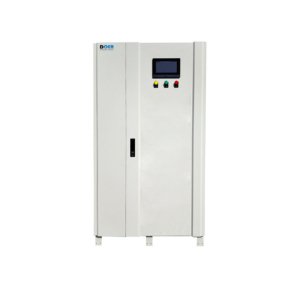
The static stabilizer is the cutting-edge products and now widely accepted by many new customers, which makes it popular on the market. This is the most advanced technology by utilizing electronic converters to regulate voltage with incredible speed and precision. Compact in size and light in weight compared to Servo stabilizer and Induction Voltage Stabilizer. It is free maintenance, The Static Voltage Stabilizer include two types, one is IGBT voltage stabilizer, and another one is SCRs voltage stabilizer.
IGBT Voltage Stabilizer
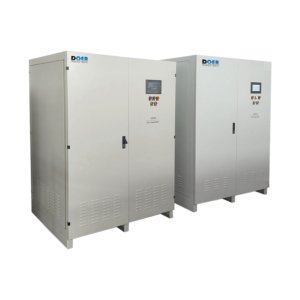
The IGBT static voltage stabilizer is a new generation of Static Voltage Stabilizer with PWM controlled IGBT technology, the Delta Voltage is added and subtracted at the primary of buck-boost transformer by IGBT based AC-AC converter to regulate output voltage. The system uses IGBTs as power switches. Direct AC-AC converter circuits improve the overall system response and fast voltage correction. 20Khz PWM control operation using dsPIC controller to achieve correction time of 1 to 1.5 cycle.
Advantages:
- PWM controlled IGBT technology
- Applicable to wide supply voltage variations of in excess of ±25% or even greather than 30% and 40%
- Delivering voltage accuracy on the output of 1% to optimal 0.5%
- Free maintenance
- High dynamic response: 10ms
- Correction Time: 20ms-30ms
- Stepless auto voltage regulation
- Surge arrestor: Class II4P 40KA, to protect loads against high spikes and transient voltage
- independent phase control,three phase modulation: Each phase voltage is independently stabilized without affecting each other, with a high stabilization accuracy of+-1%.
- Buit-in Auto Bypass: has an internal bypass system that ensures load to the mains utility in case of overload or stabilizer in malfunction
SCRs Voltage Stabilizer
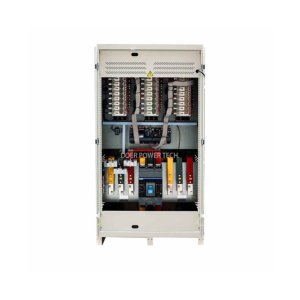
SCRs static voltage stabilizer is an industrial voltage regulator that uses numerical control technology and thyristor contactless switches. It relies on DSP and fast compensation technology to achieve a millisecond level response, with a voltage stabilization accuracy of ±1%, supporting three-phase independent adjustment and 100% unbalanced load; This device adopts industrial grade integrated circuits and isolation compensation transformer design. Through true effective value calculation and sine wave superposition compensation technology, it adopts the latest DSP operation measurement chip control technology, fast AC sampling technology, effective value correction technology. It combines intelligent instruments, fast voltage stabilization, and fault diagnosis to make the product safe, efficient, and precise.
How It Works?
A sensing circuit micro-controller samples the output voltage and identifies discrepancies from the predetermined voltage value. If a deviation is detected, the micro-controller activates an SCR to connect a different tap on the transformer’s secondary winding, adjusting the voltage.
Key Benefits:
- Ultra-fast correction time, no moving parts (except fans for cooling), and high precision, Extremely reliable and quiet.
- Applicable to wide supply voltage variations of in excess of ±25% or even greather than 30%
- Delivering voltage accuracy on the output of 1%, accuracy usually 1%-5% adjustable.
- Free maintenance
- independent phase control,three phase modulation: each phase voltage is independently stabilized without affecting each other, with a high stabilization accuracy of+-1%.
- Buit-in Auto Bypass: has an internal bypass system that ensures load to the mains utility in case of overload or stabilizer in malfunction
- Commonly used for highly sensitive equipment like data centers, medical devices, and advanced communication systems.
How to Choose the Right Voltage Stabilizer: 5 Key Factors
Now that you know the types, here’s a simple checklist to guide your purchase:
1. Calculate Your Power Requirement (VA Rating)
This is the most critical step. Check the power rating of your appliance (usually mentioned in Watts or Amps on a label). To find the required stabilizer capacity in VA, use this formula:
For single appliance: Required VA = (Appliance Wattage) / 0.8 (assuming a typical power factor of 0.8). It’s always safer to add a 20% buffer at least for a sufficient power margin, to minimize the risk of exceeding the kW rating of stabilizer by sizing the kVA rating of a load to be no greater than 70% of the kVA rating of the stabilizer. Taking 5kVA Air-cons For example, calculate the total load and add a sufficient margin on power rating, the 5kVA Air-cons would need a stabilizer of at least 5 / 0.7 = 7.14 KVA, so a 10 kVA model rating stabilizer would be a safe choice.
2. Check the Input Voltage Range
Stabilizers are designed to work within a specific input range (e.g., in many cases, ±20% voltage swing is in common, take nominal voltage 380Vac±20%, 304Vac to 456Vac 3 Phase). Choose one that matches the typical voltage fluctuations in your area. If the voltage in your area drops very low or very high like nominal voltage±30%, you’ll need a stabilizer with a wider “brown-out” protection range. The static voltage stabilizer is well considered for a wide input voltage range particularly in 25%-40% input range.
3. Match the Stabilizer Type to Your Equipment
For industrial machinery: A Servo type stabilizer is the best choice for its smooth correction and durability. For a very limited installation space, critical, sensitive medical or IT equipment which requires higher voltage precision and fast correction time: A Static type stabilizer will provide the speed of correction and precision that required.
4. Consider Additional Features
- Remote Control: remote control via PC through RS485 interface Modbus RTU , monitor and remote stabilizer, to control start or stop, parameters setting on PC, giving you peace of mind.
- AC Power Filter for Add-on options, provide more stable and pure power supply to your application loads, reducing waveform noise.
- Step Up or Step Down Voltage Conversion: for example three phase 415Vac±20% Europe supply standard to American supply 208Vac±1%
- Protection Features: considering a 200%, 300% overload capability for heavy industrial appliance, with short circuits, and overheating protections.
5. Choose a Reliable Supplier
Don’t compromise on quality for a slightly cheaper price. A good voltage stabilizer is a long-term investment in the safety of your valuable equipment. Stabilizers made in China with good price is well considered, but Look for brands with good after-sales service and warranties are the essential.
Conclusion
A voltage stabilizer is an essential device for protecting your electronic investments in areas with unstable power. By understanding the different types—Servo, Induction and Static Stabilizer—and carefully assessing your power needs, input voltage swing range, and equipment sensitivity, you can select the perfect protector.

