
In today‘s industrial applications, power quality is a necessity. From precision CNC machining to sensitive medical equipment, voltage instability can lead to costly downtime and equipment malfunction. Traditional servo motor voltage stabilizers have served industries for decades, but they come with inherent limitations: mechanical wear, slow response times, and limited flexibility.
IGBT voltage stabilizer—a new generation of static voltage regulator that is redefining what’s possible in power protection.
What Makes IGBT Technology Different?
At the core of this static voltage stabilizer lies Insulated Gate Bipolar Transistor (IGBT) technology combined with Pulse Width Modulation (PWM) control. Unlike traditional servo stabilizers that rely on electro-mechanical servo motors and carbon brushes to adjust voltage, IGBT-based static stabilizers use fully solid-state electronic switching technology.
The result? Voltage correction is much more faster than servo stabilizers. While a servo stabilizer might take 0.5s-1.0s to respond to a voltage fluctuation, an IGBT stabilizer corrects within milliseconds—typically less than 10ms. This speed is critical for protecting sensitive electronic equipment that cannot tolerate even momentary voltage deviations.
Key Benefits Over Traditional Stabilizers:
| Feature | IGBT Static Stabilizer | Servo Stabilizer |
|---|---|---|
| Response Time | <20ms | 2s–5s |
| Accuracy | ±0.5%–1% | ±2%–3% |
| Moving Parts | None | Carbon brushes, motors |
| Maintenance | Minimal | Regular carbon brush replacement |
| Reliability | Higher (no mechanical wear) | Lower (mechanical parts degrade) |
IGBT-based static stabilizers operate at 95%–98% efficiency with superior precision and reliability.
One Case Study – The 150kVA IGBT Voltage Stabilizer – Versatility Redefined
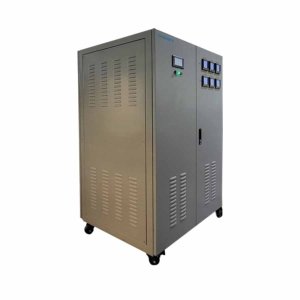
The 150kVA IGBT Voltage Stabilizer takes this advanced technology and adds a level of versatility unmatched in the industry. It is designed to solve one of the most common challenges had by user: different facilities operate on different voltage values.
The 150kVA Stabilizer Configured Multi-Tap Transformer – One Unit, Three Voltage Configurations
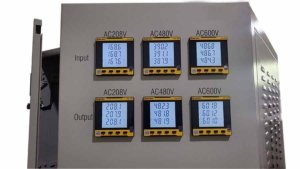
The stabilizer features an internally multi-tapped transformer that can be manually configured to match three distinct input and output voltage standards:
- 208V – Commonly used for commercial, powering large appliances and industrial machinery in North American. 208V systems are typically derived from 208Y/120V three-phase Wye networks.
- 480V – One typical industrial voltage in the United States, widely used to run large motors, HVAC and manufacturing equipment. Most industrial application needs 480V 3 phase power supply.
- 600V– Primarily used in heavy industrial environments for large high-power machinery where longer transmission distances with lower current loss are required. 600V systems are common in manufacturing and wastewater facilities etc.
This multi-voltage capability means a Single Stabilizer Unit can handle facilities across North America regardless of their incoming voltage standard—eliminating the need to stock multiple units for different locations.
Wide Input Voltage Range
Beyond the standard voltage configurations, the stabilizer accepts an input voltage range of ±30% around the nominal value. This wide tolerance ensures reliable operation even in areas with significant grid fluctuations or unstable power conditions. For example, on a 208V nominal system, the unit can handle inputs from approximately 145V to 270V without compromising output stability.
High Precision – ±0.5% to 1%
With an output voltage accuracy of ±0.5% to 1% , this stabilizer delivers laboratory-grade power protection. This level of precision is essential for:
– Medical equipment (MRI, CT scanners, X-ray machines)
– Semiconductor manufacturing equipment
– CNC machines
– Data center servers and communication systems
– Laboratory instruments and calibration devices
Three-Phase Independent Adjustment
Unlike many stabilizers that adjust all three phases together, the static voltage stabilizer unit features independent phase control. Each phase can be adjusted separately, making it ideal for environments with unbalanced loads—a common challenge in facilities where single-phase equipment is distributed unevenly across the three phases.
Comprehensive Monitoring and Protection
Each phase is equipped with its own digital voltage, current, and power meter, allowing operators to monitor input and output parameters at a glance. The unit also provides:
– Overload protection
– Short circuit protection
– Over voltage and under voltage protection
– Over frequency and under frequency protection
– Automatic bypass in case of internal failure
Where Does This Matter?
Industrial Manufacturing
Factories with large motors, compressors, and automated production lines need stable volts to prevent unexpected shutdowns. A voltage sag that lasts just a few cycles can trip a PLC. The IGBT stabilizer‘s millisecond response time ensures that such events are corrected before they impact the production systems.
Commercial Buildings
Large office complexes, malls, and hotels operate on 208V or 480V systems. Elevators, escalators, HVAC systems, and lighting all depend on consistent voltage. A single stabilizer can protect an entire facility’s critical loads.
Healthcare Facilities
Hospitals cannot afford power-related equipment failures. MRI machines, CT scanners, and patient monitoring systems require voltage stability that only a ±0.5% precision stabilizer can provide.
Data Centers
Servers are among the most voltage-sensitive loads in existence. Even brief voltage fluctuations can corrupt data in failure. The ultra-fast correction of an IGBT voltage stabilizer provide the clean power in static state that data centers demand.
The IGBT voltage stabilizer represents a fundamental leap forward in voltage regulation technology. It combines the speed and precision of solid-state electronics with the flexibility of a multi-tap transformer design, delivering one unit that adapts to three different voltage standards—208V, 480V, and 600V.
For facility managers, equipment manufacturers, and industrial operators who need reliable, precision power protection across multiple sites or voltage configurations, this is the solution that eliminates complexity.
